Takenoko no Sato | Japan’s Beloved Chocolate Snack - GTN MAGAZINE
日本語
日本語
English

Takenoko no Sato | Japan’s Beloved Chocolate Snack

When visiting Japan, you will surely encounter many charming sweets.

Among them, "Takenoko no Sato" is particularly popular and can be called a national sweet for Japanese people.

This snack is not just a chocolate confection; it is a product filled with Japanese food culture and playfulness, allowing you to experience the essence of Japan.

In this article, we will introduce the charm, history, ways to enjoy, and cultural positioning of "Takenoko no Sato" in detail for international visitors to Japan. Whether you use it as a reference for choosing souvenirs or as a snack to satisfy your hunger during your stay in Japan, please enjoy the world of "Takenoko no Sato."

What is Takenoko no Sato?

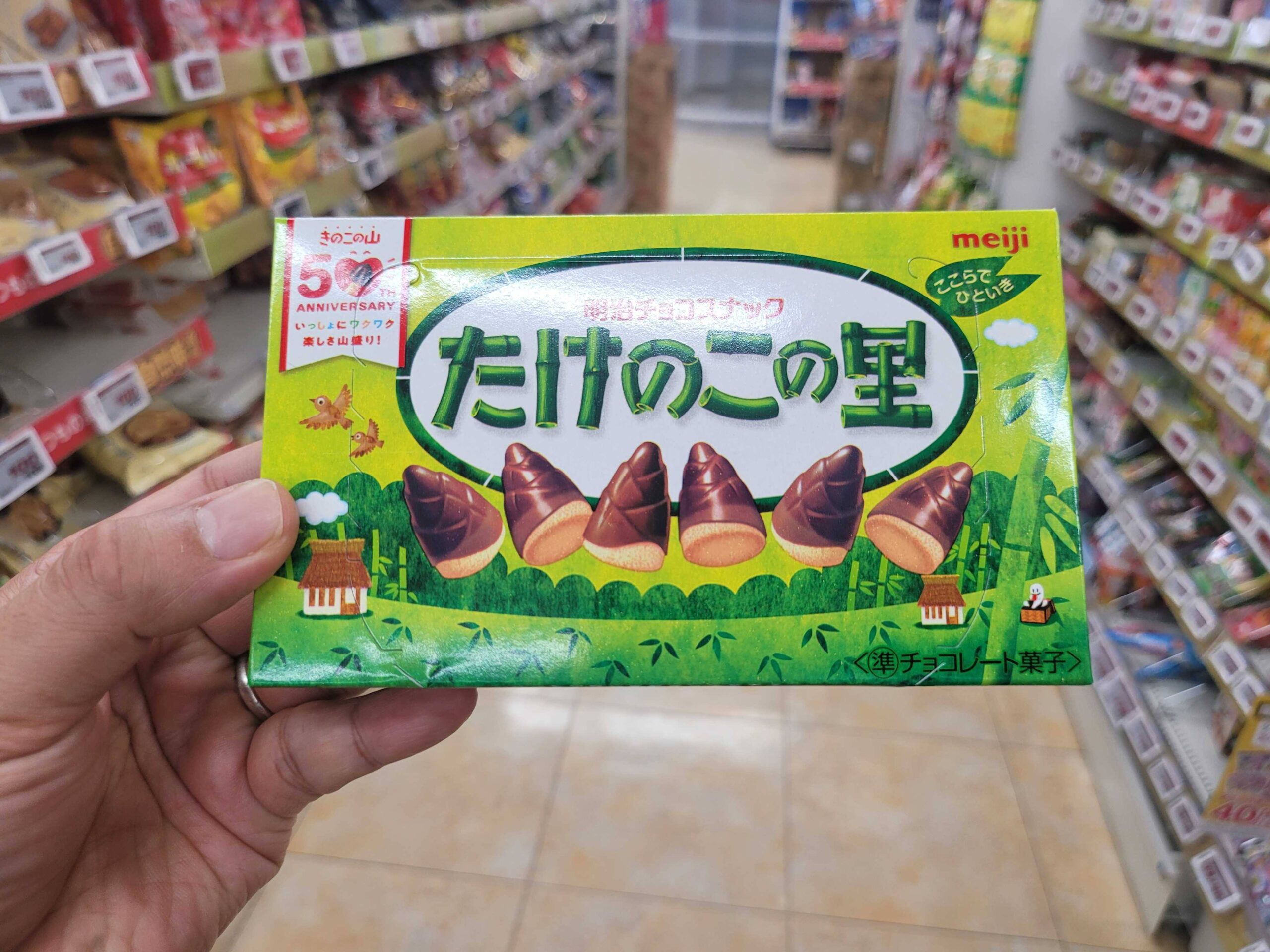
"Takenoko no Sato" is a chocolate snack manufactured and sold by Meiji Seika of Japan since 1979.

Its characteristic is its unique design, featuring a cookie shaped like a bamboo shoot (takenoko) coated with milk chocolate on the upper part.

The exquisite balance between the fragrant cookie dough and the mellow chocolate is the reason why it has continued to be loved by a wide range of generations.

The name "Takenoko no Sato" (Village of Bamboo Shoots) is inspired by the scenery of Japanese satoyama (rural landscapes), and the packaging also depicts a lush Japanese countryside scene.

This naming and its cute appearance are also part of the charm that attracts many people.

Product NameTakenoko no Sato
ManufacturerMeiji Co., Ltd.
Release Year1979
FeaturesA snack consisting of bamboo shoot-shaped cookies coated in chocolate
Net Weight (Standard Size)63g
English NameCHOCOCONES


The Secret Story of the Birth of Takenoko no Sato

"Takenoko no Sato" was born in 1979 as a sister product to "Kinoko no Yama" (released in 1975), which was released before it.

Although "Takenoko no Sato" appeared four years after "Kinoko no Yama," these two products have had a significant impact on Japanese snack culture for a long time since then.

"Kinoko no Yama" was planned around 1970, five years before its release.

At that time, Meiji Seika was considering sales strategies for small chocolates such as Apollo Choco and Choco Baby.

The prototype brought by the person in charge at the Osaka factory was the original form of "Kinoko no Yama," but at that time, the concept of a chocolate snack itself was rare, and it reportedly took time until its release.

The reason why "Takenoko no Sato" appeared later is said to be that it was born from a concept to further expand the Japanese countryside scenery following the success of "Kinoko no Yama."

There are unique innovations in the texture of the cookie and the way it is combined with chocolate, and it is characterized by a texture and taste different from "Kinoko no Yama."

Interestingly, both products have hardly changed their basic shapes or concepts from their initial release to the present.

This shows that they have a universal charm that captures the hearts of Japanese people.

Kinoko no Yama and Takenoko no Sato | Eternal Rivals

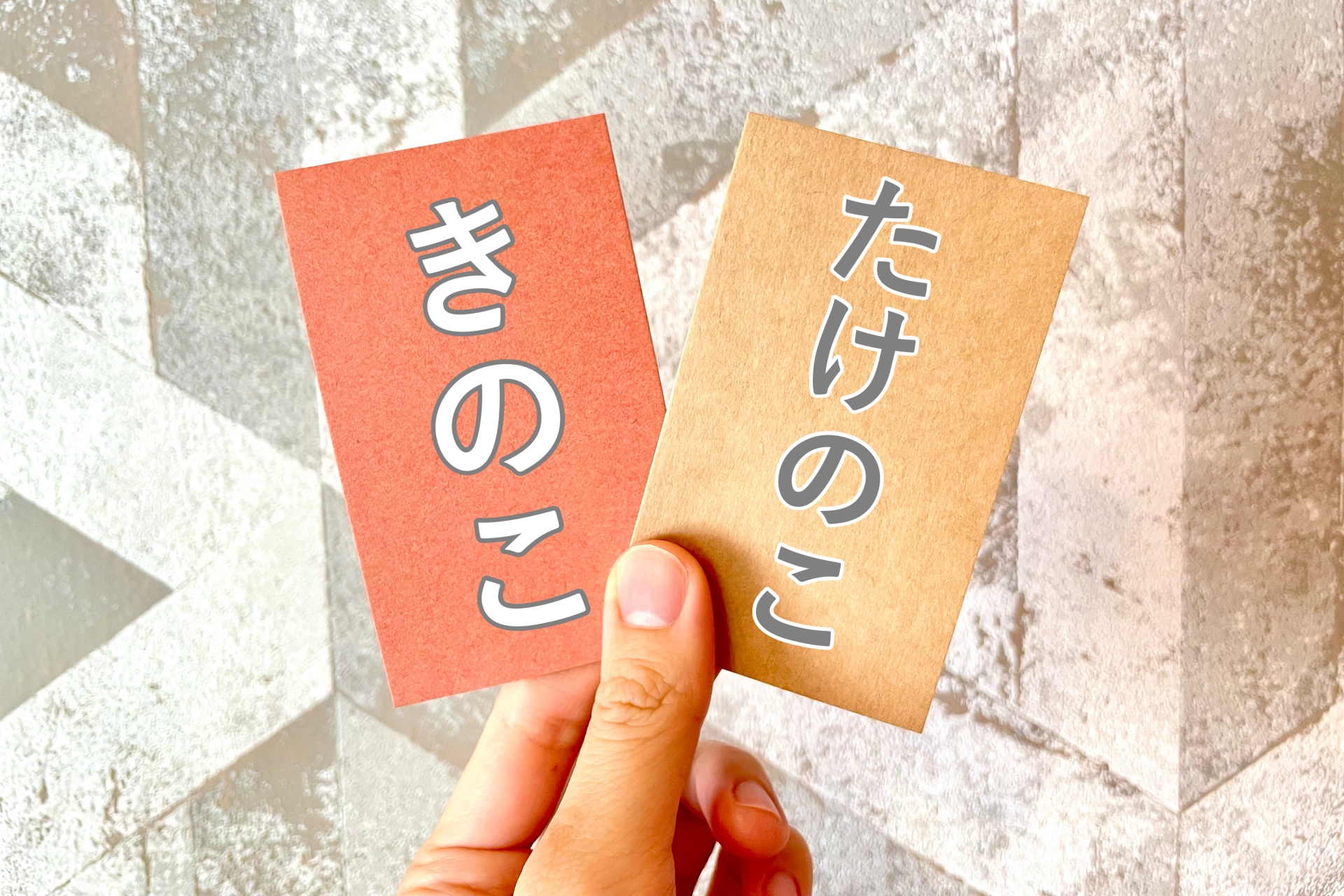
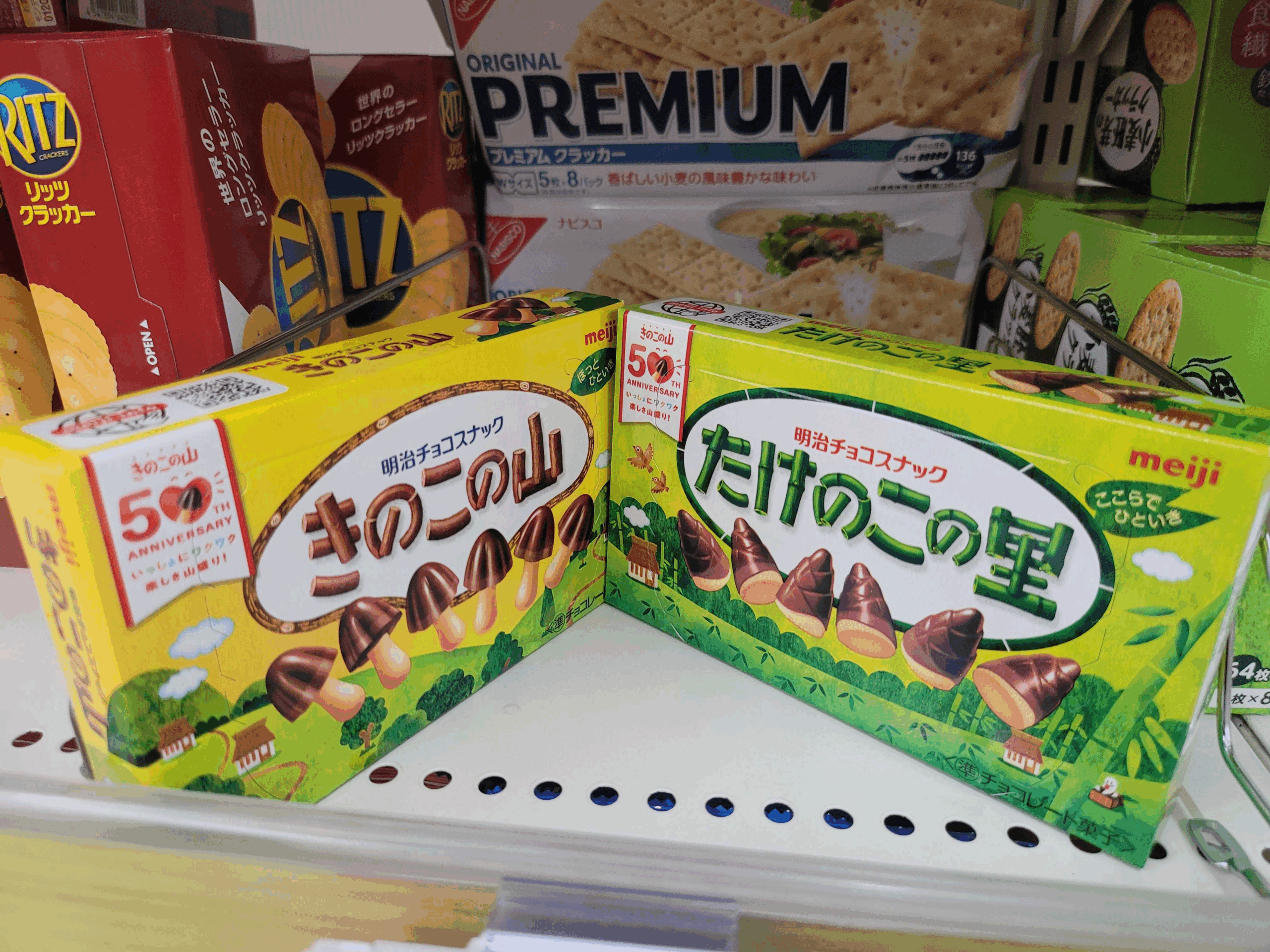
In Japan, when talking about "Takenoko no Sato," the comparison with "Kinoko no Yama" always comes up.

These two products have been the subject of heated debate over which is more delicious, to the extent that it is called the "Kinoko-Takenoko War" in Japan.

Differences Between the Kinoko Faction and the Takenoko Faction

 Kinoko no YamaTakenoko no Sato
Release Year19751979
ShapeMushroom-shapedBamboo shoot-shaped
Biscuit PartPretzel dough (Crunchy)Cookie dough (Crumbly)
Chocolate AmountMoreLess
Eating StyleMany eat from the head firstMany eat it all at once

To liven up this "Kinoko-Takenoko War," Meiji Seika has developed a unique campaign called the "National General Election" since 2001, creating fictional political parties called the "Kinoko Party" and the "Takenoko Party."

In this general election held every few years, it has become an event where consumers actually vote to compete for popularity.

In the general election held in 2018, the Takenoko Party won, but in 2019, the Kinoko Party won by a large margin, so the results vary each time.

Interestingly, there is a tendency for preferences to be divided by age group and region; survey results show that "Kinoko no Yama" is popular among younger generations, while "Takenoko no Sato" is popular among those in their 40s and older.

Even within Meiji, employees are divided into the "Kinoko Party" and the "Takenoko Party." Although many in the management layer, including the president, belong to the "Kinoko Party," it is said that the "Takenoko Party" is the majority in the company as a whole.

Each employee reportedly holds a "Party Member Card," and the topic of "Which faction are you?" often comes up within the company.

This "Kinoko-Takenoko War" has gone beyond a mere marketing strategy and has become a social phenomenon rooted in Japanese snack culture.

For international visitors to Japan, comparing these two and finding out which faction they belong to can be said to be one way to enjoy Japanese snack culture.

"Takenoko no Sato" Spreading to the World | Overseas Expansion

"Takenoko no Sato" is sold not only in Japan but also in various countries around the world.

Particularly in North America and Asian countries, it is developed with package designs and product names tailored to local preferences.

In the United States, it is sold under the name "CHOCOCONES."

This is a coined word combining chocolate (Choco) and cone (Cone), which means a conical shape.

On the other hand, "Kinoko no Yama" is also sold under the name "CHOCOROOMS," which combines chocolate (Choco) and mushroom (Mushroom).

Interestingly, there is a tendency for "Kinoko no Yama" to be more popular than "Takenoko no Sato" overseas.

This is a point that differs from the survey results in Japan, and it is thought that cultural preferences for texture and familiarity with the appearance are influential.

In addition, Meiji Seika's global expansion has been accelerating in recent years, and local production lines for "Kinoko no Yama" and "Apollo" are operating in Singapore.

Following the increasing popularity of "Takenoko no Sato" among international visitors to Japan, sales expansion overseas is being promoted.

Takenoko no Sato and Angkor Wat | Unexpected Similarity

たけのこの里とアンコールワット

As an interesting episode related to "Takenoko no Sato," the similarity in shape with the Cambodian World Heritage site Angkor Wat has become a topic of conversation.

Because the shape of the bamboo shoot-shaped cookie and chocolate resembles the silhouette of the towers of Angkor Wat, some say it wouldn't be out of place to call it "Angkor Wat Chocolate."

In 2016, the Japanese web media "RocketNews24" conducted a project to take "Takenoko no Sato" to Angkor Wat in Cambodia and ask for the reactions of local people.

The local people also evaluated it as "similar," and the episode introduced that its taste was also well-received.

This similarity is a pure coincidence, but there is a possibility that foreigners who do not know "Takenoko no Sato" might associate it with "Is this a chocolate snack in the shape of Angkor Wat?" when they see it for the first time, making it an international topic.

Reasons for Popularity Among Foreign Travelers

Among foreign tourists visiting Japan, "Takenoko no Sato" has become one of the popular souvenirs.

There are several possible reasons for this.

Unique Shape and Concept

The shape imitating a bamboo shoot is a unique design that is rarely seen in other countries.

The concept inspired by Japanese satoyama also gives a sense of Japaneseness.

Exquisite Balance of Taste

Japanese snacks tend to be less sweet compared to those in Western countries.

In "Takenoko no Sato" as well, the sweetness of the chocolate and the fragrance of the cookie are exquisitely balanced, and it is evaluated as "just the right sweetness" by many foreigners.

Convenience and Affordability

Some are individually wrapped, making them easy to carry as snacks during travel, and the price is also affordable.

The fact that they can be easily purchased at Japanese convenience stores and supermarkets is also a reason why they are favored by tourists.

Cultural Experience of the "Kinoko-Takenoko War"

The aforementioned rival relationship provides an opportunity not just to eat the product but to experience Japanese snack culture.

Many international visitors to Japan enjoy comparing "Kinoko no Yama" and "Takenoko no Sato" and posting which faction they belong to on social media.

Suitability as a Souvenir

There are sizes ideal for "baramaki" (distributing to many people) souvenirs in small portions, and because they last a long time, they are suitable for giving as presents to friends and family after returning home.

In addition, the Japanese-style design of the packaging is also well-received.

According to surveys, "Takenoko no Sato" is reportedly far more popular than "Kinoko no Yama," especially among Chinese travelers.

This is analyzed to be because the texture of the cookie and the overall taste suit the preferences of Chinese consumers.

How to Buy at Japanese Supermarkets and Convenience Stores

Here is some information that will be helpful for international visitors to Japan when purchasing "Takenoko no Sato."

Where to Buy

"Takenoko no Sato" can be easily obtained at the following locations:

•Convenience stores (7-Eleven, Lawson, FamilyMart, etc.)

•Supermarkets

•Drugstores

•Station kiosks

•Airport souvenir shops

Price Range

The price of "Takenoko no Sato" varies depending on the size and packaging.

•Standard size (63g): Approx. 180 yen – 300 yen

•Share pack (Large capacity): Approx. 400 yen – 600 yen

•Small portion pack (Individually wrapped): Approx. 300 yen – 400 yen

Prices vary slightly depending on the region and store. Also, there are special packages for seasonal products or during campaigns.

Types of Packaging

There are various packaging types for "Takenoko no Sato."

•Standard box type: General boxed type, ideal for individual enjoyment

•Share pack: Large capacity type, suitable for sharing in a group

•Small portion pack: Individually wrapped, ideal for souvenirs

•Limited design package: Special designs for seasons or events

Points to Note When Taking Takenoko no Sato as a Souvenir

We have summarized the points to note when taking "Takenoko no Sato" back to your home country.

Be Careful with Temperature Management

Since chocolate is sensitive to high temperatures, it may melt during the summer or hot periods. Especially when carrying it for a long time, it is a good idea to use a cooler bag.

Check the Expiration Date

Check the expiration date at the time of purchase and choose one that fits your schedule until you return home and your distribution plan after taking it back. Usually, quality is maintained for several months from manufacture.

Quantity Limits

When purchasing in large quantities as souvenirs, regular supermarkets and convenience stores may have limited stock. If you need a large amount, we recommend purchasing at large supermarkets or mass retailers.

Duty-Free Support

At duty-free shops for tourists or large department stores, you may be able to get duty-free support if you purchase over a certain amount. Present your passport along with the receipt.

Check Import Restrictions

Depending on the country you are returning to, there may be restrictions on bringing in food. We recommend checking in advance.

Variations | Various Flavor Developments

In addition to the standard milk chocolate flavor, "Takenoko no Sato" has various limited flavors.

Depending on the time of your visit to Japan, you may be able to enjoy seasonal flavors.

Standard Flavors

•Original (Milk Chocolate)

•Adult's Takenoko no Sato (For adults with higher cocoa content)

Limited Flavors Released in the Past

•Strawberry

•Mixed Berry & Milk

•Uji Matcha

•Kuromitsu (Brown Sugar Syrup)

•White Chocolate

Special Packages

Also, special packages for Japanese holidays and special events are popular.

For example, seasonal designs for Halloween, Christmas, Valentine's Day, and New Year's have value as more special souvenirs.

In 2025, products incorporating Japanese tastes, "Kinako no Yama" and "Takenoko no Kuromitsu," were also released for international visitors to Japan.

These products using "Kinako" (roasted soybean flour) and "Kuromitsu" (brown sugar syrup), which are traditional Japanese flavors, are also recommended for foreign tourists interested in Japanese culture.

Summary | Takenoko no Sato as a Japanese Snack Culture Experience

"Takenoko no Sato" has gone beyond being a mere snack and has become an existence that symbolizes Japanese snack culture.

Its unique shape, exquisite taste, and the cultural phenomenon called the "Kinoko-Takenoko War" will be one of the interesting Japanese experiences for international visitors to Japan.

During your time in Japan, please compare "Takenoko no Sato" and "Kinoko no Yama" and discover which faction you belong to.

Also, if you take it home as a souvenir, you can share the unique Japanese snack culture with your family and friends along with your memories in Japan.

The charm of "Takenoko no Sato" lies not only in its taste but also in the culture and stories surrounding it.

Why not touch upon Japanese creativity and humor through this small chocolate snack?


関連記事