How to Use a Credit Card in Japan: A Beginner’s Guide for Foreign Residents and International Students - GTN MAGAZINE
日本語
日本語
English

How to Use a Credit Card in Japan: A Beginner’s Guide for Foreign Residents and International Students

“Your credit card has arrived, but the envelope is full of documents in Japanese, and you’re not sure what to do first.”

If this sounds familiar, this guide is for you.

Here’s what you need to know: Before you start using your new credit card, there are five important steps to take.

<5 Things to Do When Your Credit Card Arrives>

  • 1. Check your name and the expiration date
  • 2. Sign the signature panel (only if your card has one)
  • 3. Check your PIN
  • 4. Set up your bank account for payments
  • 5. Register for the cardholder website or app


Once you've completed these steps, you can start using your credit card in stores and online. After making a purchase, check your credit card statement to make sure the amount is correct.

For more information on how credit cards work and how to decide whether you need one, check out this article.


This article is not intended to promote any particular credit card. GTN has been supporting foreign residents in Japan for 20 years and offers services in up to 25 languages (as of July 1, 2026). In this guide, we explain the steps you need to take before using your first credit card in Japan.

From Applying for a Credit Card to Receiving It

There are four main steps between applying for a credit card and receiving it. The application process and delivery time vary depending on the card company.

  1. Submit your application (online, at a store, or through another application channel).
  2. The card company reviews your application (screening).
  3. The card company sends your credit card.
  4. You receive your credit card.

To learn more about what card companies check during the screening process, read this article.

Your Credit Card May Require In-Person Delivery to You

Your credit card may be sent by a special type of mail called Restricted Delivery Mail (本人限定受取郵便). This service requires the person named on the mail to receive it in person. In some cases, a person designated by the sender may also be allowed to receive it.

With this delivery service, you will first receive an arrival notice (到着通知書) informing you that your mail has arrived. When collecting your card, you will need to show an acceptable identification document, such as a government-issued photo ID.

You can use your Residence Card (在留カード) as identification, as long as it is still valid on the day you receive the mail. Please note that this type of mail cannot be forwarded to another address.

Starting in April 2027, the types of identification accepted for this service are expected to be limited to four documents: a driver's license, My Number Card, Residence Card, or Special Permanent Resident Certificate. Passports will no longer be accepted.

Source: Japan Post – Restricted Delivery Mail (本人限定受取郵便)

To avoid problems when receiving your credit card, it's a good idea to check the following in advance:

  • Make sure the address you entered in your credit card application matches the address on your Residence Card.
  • Check that your name is displayed on your mailbox or front door.
  • If you have recently moved, make sure you have completed the necessary address registration procedures.


You can also check with your local city or ward office about moving procedures and address registration.

5 Things to Do Before Using Your New Credit Card

Once your credit card arrives, make sure to check these five things before using it.

What to DoWhat to Check
1. Check your name and expiration dateMake sure your name is spelled correctly in Roman letters and check when your card expires.
2. Sign the back of your cardIf your card has a signature panel, sign it. If there is no signature panel, you can skip this step.
3. Check your PINMake sure you remember the four-digit PIN you chose when applying.
4. Set up your bank account for paymentsConfirm that you have registered the bank account from which your credit card payments will be automatically withdrawn.
5. Register for the cardholder website or appSet up access so you can check how much you have spent with your card.

Check Your Name and Expiration Date

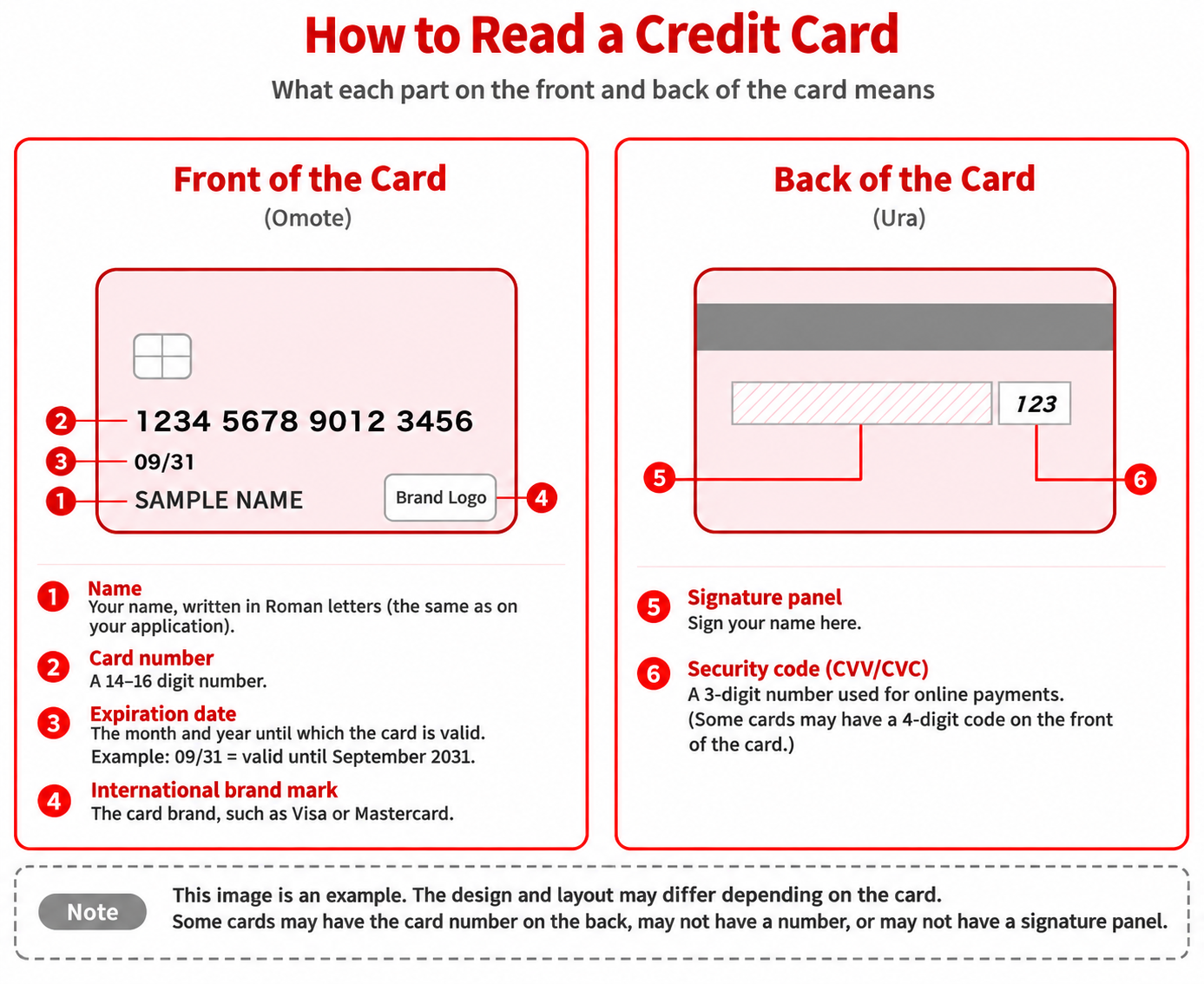
First, check the name printed on your credit card. Your name may be written in Roman letters. If your name is spelled incorrectly, contact your card company as soon as possible.

Next, check the expiration date. This tells you the last month you can use your card. It is usually written in "MM/YY" format, such as "09/31". In this example, the card is valid until the end of September 2031.

Sign the Back of Your Card

Some credit cards no longer have a signature panel (the space on the back of the card where you sign your name). If your card does not have one, you can skip this step.

If your card has a signature panel, sign your name there. Some card companies allow you to sign in Roman letters, kanji, hiragana, or katakana, without requiring a specific writing style. If you want to sign in your native language, check your card company's guidelines first.

Sources: Lawson Bank FAQ: Does the signature on the back of a credit card have to be in Roman letters? / Mitsubishi UFJ NICOS FAQ: Does the signature on the back of a card have to be in English letters?

Since April 2025, credit card payments at stores in Japan generally require you to enter your PIN instead of signing. However, some cards or payment terminals may still require a signature. In that case, make sure your signature matches the one on the back of your card. Using the same signature as the one in your passport can make it easier to remember.

Source: JCB FAQ

Check Your PIN

Your PIN (Personal Identification Number) is a number you enter when making payments in stores. Since April 2025, entering a PIN has generally been required when paying by credit card at stores in Japan. You may have chosen a four-digit PIN when applying for your card.

Source: JCB – Credit Card PIN

Before using your card, make sure you remember your PIN. Never share your PIN with anyone, including family members, friends, or even employees of your card company. Avoid using numbers that are easy for others to guess, such as your birthday.

We plan to explain what to do if you forget your PIN in a separate article.

Set up your bank account for payments

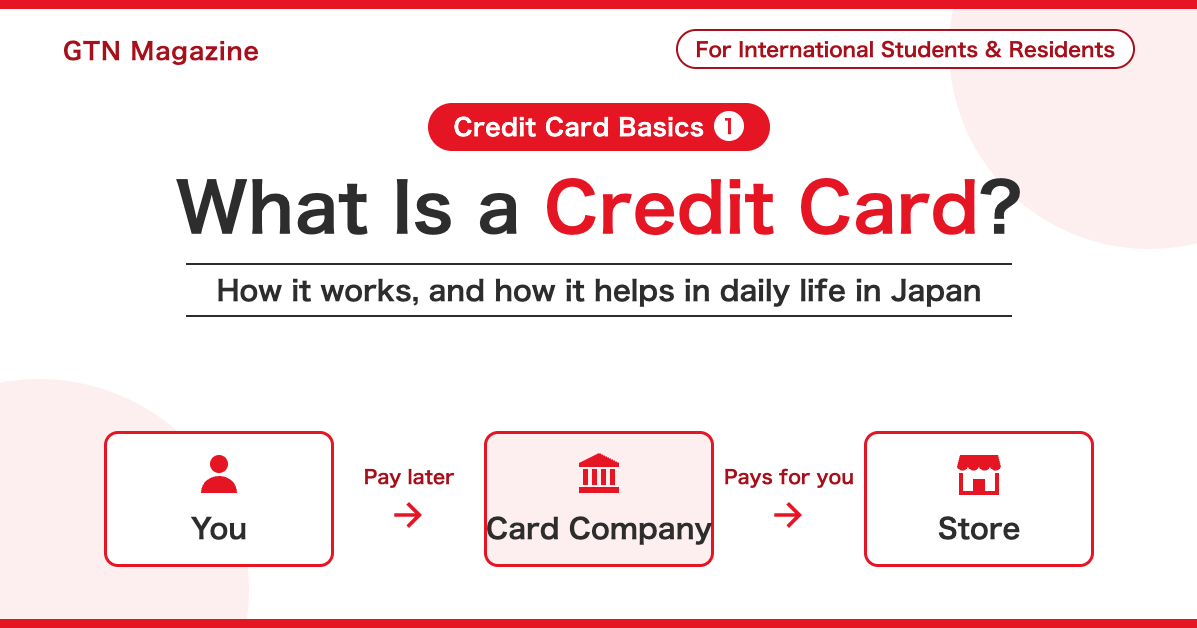
When you use a credit card, the amount you spend is withdrawn from your bank account at a later date. To make these payments, you need to register a bank account for automatic withdrawals (口座振替, koza furikae). This allows your credit card payments to be automatically deducted from your bank account each month.

Keep the following points in mind when setting up your payment account:

You need to register a Japanese bank account. Some card companies require the account to be in your own name.

You may be able to register your account online or by completing and returning the documents sent to you. The process varies depending on the card company.

Until your bank account registration is complete, you may need to make payments using a bank transfer form or a payment slip at a convenience store. Additional fees may apply.

If you don't have a Japanese bank account yet, you will need to open one first. The Financial Services Agency (FSA) also provides information on how to open a bank account in Japan and what procedures to follow when leaving the country.

Source: Financial Services Agency (FSA) – Financial Services for Foreign Residents in Japan

Register for the Cardholder Website or App

Some card companies offer a website or smartphone app for cardholders. Once registered, you can check your credit card statement, payment due dates, and remaining available credit at any time.

Some apps also support languages other than Japanese. It's a good idea to check whether customer support is available in a language you understand, in case you need help.

What Is a Credit Limit? Why Your First Credit Card May Have a Lower Limit

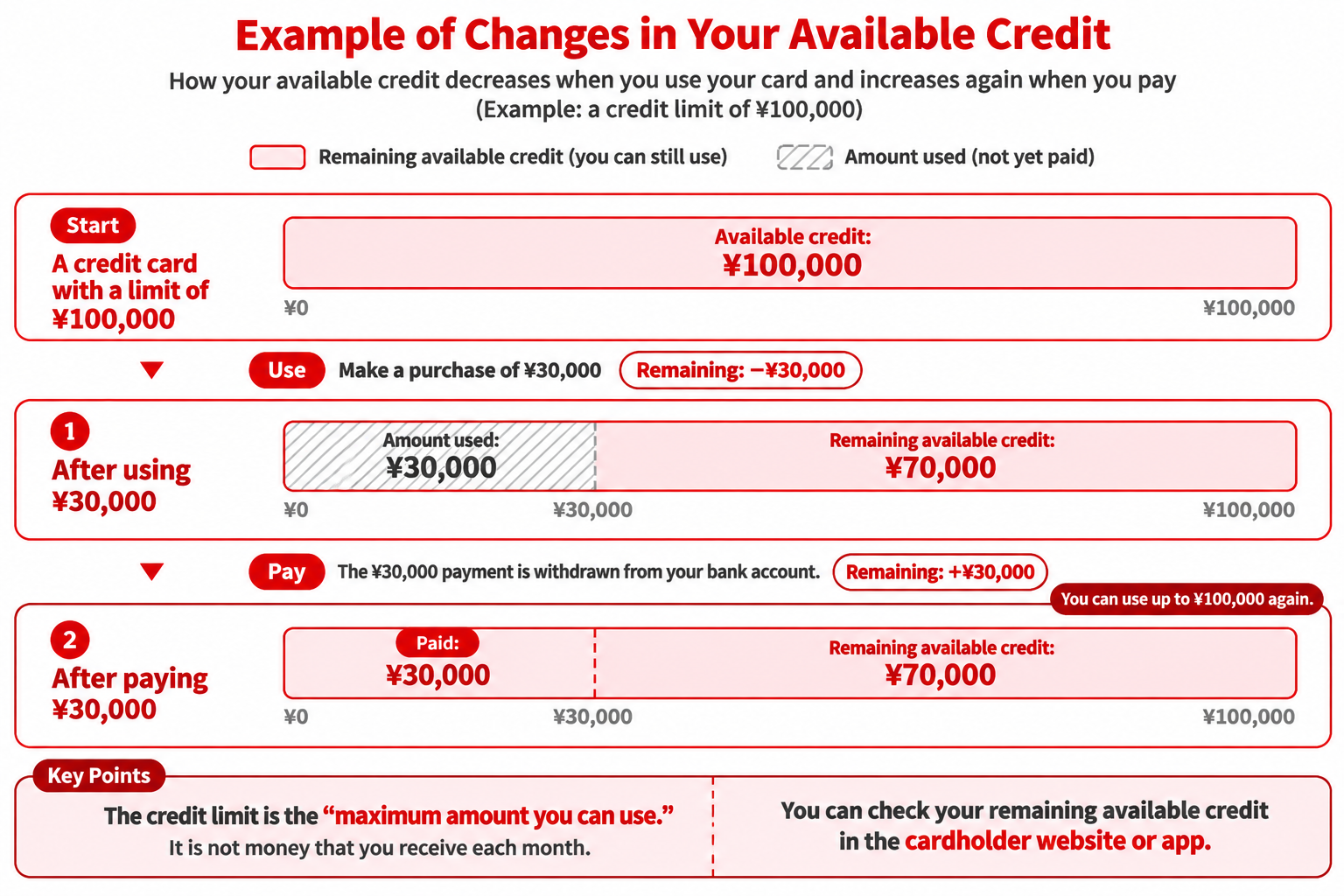
A credit limit is the maximum amount you can spend using your credit card. In Japan, it is also called the "available credit limit" (利用可能枠).

If this is your first credit card, your credit limit may be set relatively low. However, this does not necessarily mean that the card company considers you untrustworthy.

Your Available Credit Decreases When You Spend and Increases When You Pay

Your remaining available credit decreases when you use your card and increases again after your payments are processed.

For example, suppose your credit card has a limit of ¥100,000, and you make a purchase of ¥30,000. Your remaining available credit will decrease to ¥70,000.

Once the ¥30,000 payment has been withdrawn from your bank account and processed, your available credit will return to ¥100,000.

You can check your remaining available credit through your cardholder website or app. If you exceed your credit limit, your card may be declined when shopping in stores or online.

Why Your Credit Limit May Be Set Lower

In Japan, when issuing credit cards that allow installment payments or revolving payments, card companies are required by law to check how much a person can reasonably afford to repay. This is required under the Installment Sales Act (割賦販売法). The assessment includes factors such as annual income and existing debts.

Source: e-Gov Law Search – Installment Sales Act, Article 30-2

If this is your first credit card, you may have little or no credit history in Japan. After reviewing your financial situation, including income from part-time jobs, the card company may set a lower initial credit limit. Your payment history in Japan can also affect your credit limit.

If you consistently make your payments on time, your card company may review your credit limit. However, an increase is not guaranteed. The timing and process for reviewing credit limits vary by card company.

Remember, your credit limit is not an amount you should spend. It is simply the maximum amount you can use. Avoid spending up to your limit, and make sure you only spend what you can afford to repay each month.

We plan to cover tips for using credit cards responsibly in a separate article.

How to Use Your Credit Card in Different Situations

You can use your credit card in four common situations: paying in stores, making contactless payments, shopping online, and paying monthly bills.

Let's look at how to use your card in each situation.

Paying in Stores

When paying at a store in Japan, you may have a conversation like this at the checkout counter.

What Store Staff May Say (Examples)What It MeansHow to Respond (Examples)
お支払いはどうされますか?How would you like to pay?カードでお願いします。
Kādo de onegaishimasu.
"By card, please."
お支払い回数は?
一括でよろしいですか?
How many installments would you like?
Would you like to pay in one payment?
一括でお願いします。
Ikkatsu de onegaishimasu.
"One payment, please."

Or: はい、一括で。
Hai, ikkatsu de.
"Yes, one payment."
暗証番号をお願いします。Please enter your PIN.Enter your four-digit PIN on the payment terminal (the machine that reads your card).
こちらにサインをお願いします。(一部の場合)Please sign here. (In some cases)Use the same signature as the one on your card's signature panel.
レシート(控え)はご利用ですか?Would you like a receipt?お願いします。
Onegaishimasu.
"Yes, please."

Or: 大丈夫です。
Daijobu desu.
"No, thank you."

"一括払い (ikkatsu barai)" means paying the full amount in a single payment. There are generally no additional fees for this payment method.

However, if you have a card specifically designed for revolving payments or one that is automatically set to revolving payments, your purchase may still be charged as a revolving payment even if you ask to pay in full ("一括で"). Before using your card, make sure to check your payment settings.

We plan to explain the differences between single payments, installment payments, and revolving payments in a separate article.

Source: National Consumer Affairs Center of Japan – Always Check Your Statements! Beware of Unintentional Revolving Payments (October 2025)

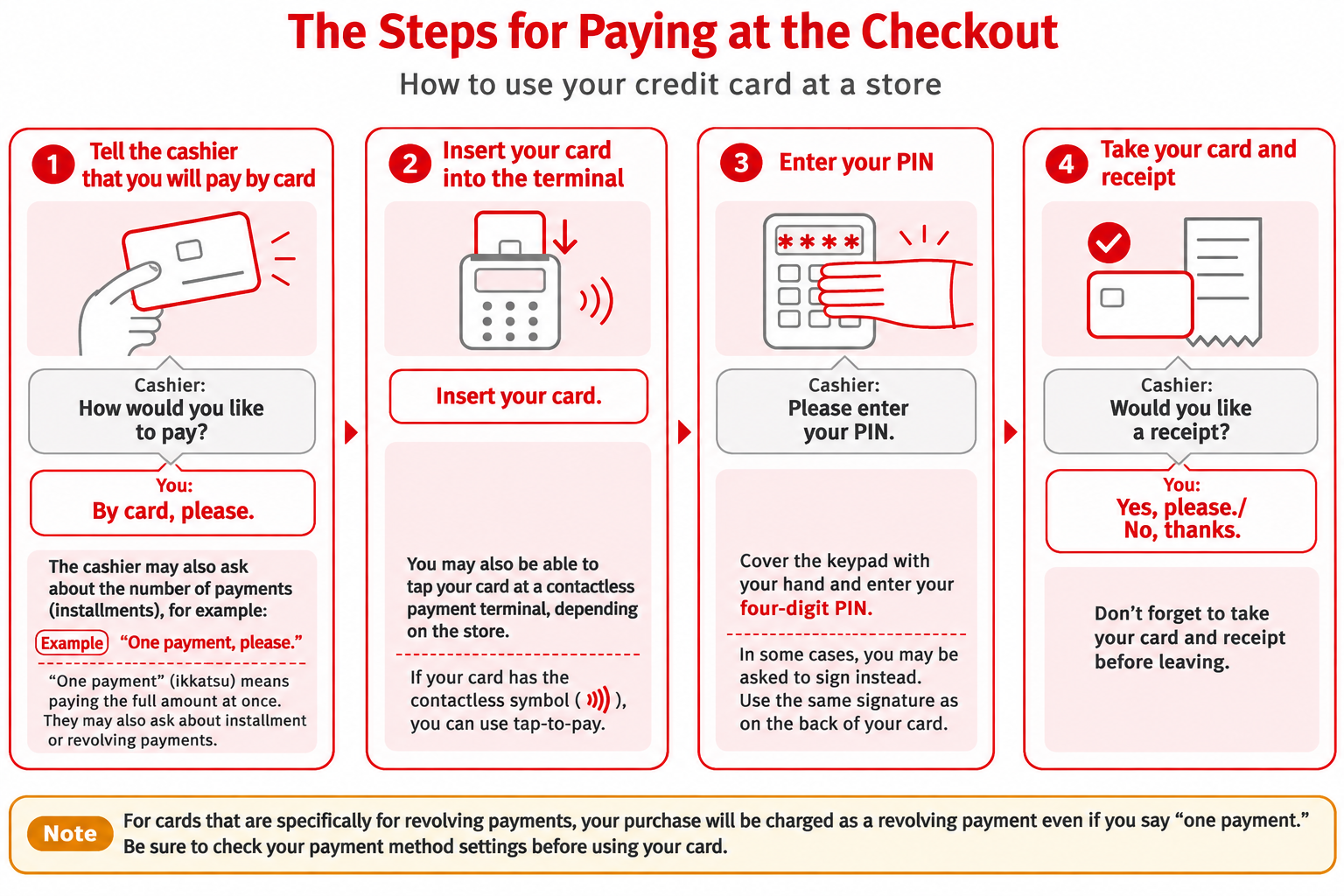
Here's how to pay with your credit card at a store:

Tell the cashier, "カードでお願いします" (Kādo de onegaishimasu – "By card, please").

Insert your card into the payment terminal (or hand it to the cashier).

Enter your PIN (or sign if required).

Take back your card and receipt.

Since April 2025, entering a PIN has generally been required for in-store credit card payments in Japan. However, depending on the transaction amount and other conditions, you may not need to enter your PIN.

When entering your PIN, cover the keypad with your hand so that others cannot see it.

Paying with Contactless Payment

Contactless payment allows you to pay simply by holding your card near a payment terminal. You can use this method when both your card and the store support contactless payments, usually indicated by a symbol that looks like curved waves. However, contactless payment may not always be available, even if the symbol is displayed.

Tell the cashier, "カードで(タッチで)お願いします" (Kādo de (tacchi de) onegaishimasu – "I'd like to pay by card (contactless), please").

  1. Hold your card near the payment terminal.
  2. Wait for a sound or confirmation on the screen to make sure your payment is complete.
  3. For larger purchases, you may still be asked to enter your PIN or complete additional verification, even when using contactless payment.

Paying Online

When shopping online with a credit card, you will usually need to enter the following information:

Card number (14–16 digits)

Expiration date (month/year)

Name on the card (in Roman letters)

Security code (a three- or four-digit number printed on the back or front of your card)

After entering your card details, you may be asked to complete an additional identity verification step. This is a security process used to confirm that you are the person authorized to use the card. For example, you may need to enter a one-time password sent to your smartphone.

In Japan, online stores were generally required to introduce a security system called EMV 3-D Secure by the end of March 2025 to help prevent unauthorized credit card use. As a result, you may see an identity verification screen when making an online payment.

If a verification screen appears, don't worry. Simply follow the instructions on the screen.

Sources: Ministry of Economy, Trade and Industry (METI) – Revision of the Credit Card Security Guidelines (March 2024) / Japan Consumer Credit Association – Using Credit Cards Online

Only enter your credit card details on websites you know and trust. Avoid entering your card information through links sent by email or social media messages.

Setting Up Automatic Monthly Payments

You may be able to register your credit card for automatic monthly payments, such as mobile phone bills, electricity, gas, water, and video streaming services.

You can check how to set up these payments on each service provider's website or in the documents they send you.

By paying your monthly bills with one credit card, you can easily see how much you've spent on different services in your credit card statement.

To learn more about when credit cards can be useful in everyday life in Japan, read this article.

What to Do After Using Your Credit Card

After using your credit card, check your statement to make sure the charges are correct and ensure you have enough money in your bank account before the payment due date.

Making these two things a habit can help you avoid overspending and late payments.

Check Your Credit Card Statement

Your credit card statement (利用明細, riyo meisai) is a record of your credit card transactions. You can usually view it through your cardholder website or app.

Some card companies also send paper statements, while others may charge a fee for them. Check your card company's official website for the latest information.

It may take a few days for a purchase to appear on your credit card statement. Depending on the store, it may take even longer.

If a recent purchase hasn't appeared on your statement yet, wait a few days and check again.

Sources: JCB FAQ / Saison Card FAQ

When reviewing your credit card statement, check the following:

Make sure the transaction dates, store names, and amounts are correct.

Check for any charges you don't recognize or purchases you didn't make.

Check the total amount you've spent this month.

If you notice a charge you don't recognize, contact your card company immediately.

We plan to explain what to do if you find an unauthorized charge in a separate article.

Make Sure You Have Enough Money in Your Bank Account Before the Payment Due Date

The money you spend using your credit card will be automatically withdrawn from your registered bank account on a date set by your card company.

If there isn't enough money in your account on the payment date, your payment will be considered late. You may be charged late payment fees or interest.

Late payments may also be recorded in your credit history, which could affect future applications for credit cards or loans.

You can check your payment due date through your cardholder website, app, or credit card statement.

Make sure you have enough money in your bank account by the day before your scheduled payment date. If that day falls on a weekend or public holiday, it's best to deposit the money by the previous business day.

Check your card company's instructions for the exact payment processing schedule.

The billing cycle and payment date vary depending on the card company. This includes the billing cutoff date (the last day purchases are included in a billing period) and the date the payment is withdrawn from your account.

We plan to explain these dates with specific examples in a separate article.

Tips for Using Your Credit Card Safely

To keep your credit card secure, follow these important safety tips:

Never share your PIN or security code with anyone.

Never lend your credit card to anyone, including family members or friends.

Never post photos of your credit card on social media.

Avoid entering your credit card details through links in emails or messages.

Keep your credit card in a safe place, such as your wallet, and take care not to lose it.

Only the person whose name is printed on the credit card is allowed to use it. If you lend your card to someone else, you may still be responsible for paying any charges they make.

Source: Japan Consumer Credit Association – Responsibility for Managing Your Credit Card

If you lose your credit card or notice any charges you don't recognize, contact your card company immediately.

You can find the contact information on your cardholder website, in the app, or in the documents that came with your credit card.

It's a good idea to save your card company's contact information on your smartphone so you can easily find it in an emergency.

We plan to explain what to do if you lose your card or experience other problems in a separate article.

Frequently Asked Questions (FAQ)

Q. Can I sign my credit card using characters from my native language?

A. Some card companies allow signatures in Roman letters, kanji, hiragana, or katakana, without requiring a specific writing style.

If you want to sign using characters from your native language, check the documents that came with your card or your card company's guidelines. If you're asked to sign when making a payment, use the same signature as the one on your card's signature panel.

Q. Do I need to enter my PIN or sign when paying in stores?

A. Since April 2025, entering a PIN has generally been required for in-store credit card payments in Japan.

Some cards or payment terminals may still require a signature. Depending on the transaction amount and other conditions, neither a PIN nor a signature may be necessary.

You may not be able to complete a payment if you don't remember your PIN, so make sure you know it before using your card.

Q. What should I do if I forget my PIN?

A. Contact your card company to find out how to check or change your PIN.

Entering the wrong PIN several times may cause your card to be temporarily blocked.

We plan to explain what to do if you forget your PIN in a separate article.

Q. Can I increase my credit limit?

A. Some card companies allow you to request a credit limit increase through their cardholder website or other services.

When you submit a request, the card company will review your application again. However, approval is not guaranteed.

Q. Why was my credit card declined at a store?

A. There are several possible reasons, such as exceeding your credit limit, entering an incorrect PIN, or using an expired card.

Your card may also be declined if the store does not accept its payment network, such as Visa or Mastercard.

We plan to explain the possible reasons and solutions in a separate article.

Q. What should I do if my credit card hasn't arrived?

A. First, check your mailbox for a delivery notice or missed delivery slip from Japan Post.

If your card was sent by Restricted Delivery Mail (本人限定受取郵便), you may need to collect it at a post office.

If you're still unsure what to do, contact your card company.

Summary

Once your credit card arrives, there are five important things to do before using it: check your name and expiration date, sign the signature panel (if your card has one), check your PIN, register your bank account for payments, and set up your cardholder website or app.

If this is your first credit card, your credit limit may be set relatively low. However, this does not necessarily mean that the card company considers you untrustworthy.

When paying in stores, choosing to pay in full ("一括でお願いします", Ikkatsu de onegaishimasu) generally means you won't be charged additional fees, except for certain cards, such as those specifically designed for revolving payments.

After using your card, remember to check your statement and make sure you have enough money in your bank account before the payment due date.

This article is intended to provide general information and does not recommend any particular credit card. If you have questions, check your card company's official guidelines or contact its customer support team.

To learn more about how credit cards work and what you should know before applying for one, read this article.


We plan to cover the following topics in separate articles:

  • Different Payment Methods and Interest Charges: Single payments, installment payments, revolving payments, cash advances, responsible credit card use, and payment history.
  • What to Do If You Have Problems: Lost or stolen cards, unauthorized transactions, late payments, and procedures to follow when leaving Japan.

関連記事

おすすめ記事