A Beginner's Guide to Credit Cards in Japan for Foreign Residents and International Students | When They're Useful and What to Know Before Applying - GTN MAGAZINE
日本語
日本語
English

A Beginner's Guide to Credit Cards in Japan for Foreign Residents and International Students | When They're Useful and What to Know Before Applying

“Most of my friends have credit cards, but I don't really understand how they work.”

Have you ever felt this way since coming to Japan?

If you're used to paying with cash, debit cards, or mobile wallets in your home country, the idea of paying later with a credit card might be unfamiliar. And there's nothing wrong with not knowing how they work.

Here are the key points to know.

Foreign residents and international students may be able to get a credit card if they meet the card issuer's requirements.

Also, if you choose to pay your balance in full with a single payment, you generally won't have to pay any additional fees.

And remember, whether or not to get a credit card is entirely up to you.

In this article, we'll explain how credit cards work and when they can be useful in everyday life in Japan, using simple, easy-to-understand language. This article is not intended to promote any particular credit card. Drawing on 20 years of experience supporting foreign residents and offering services in up to 25 languages, GTN has put together the basics of credit cards that foreign residents in Japan should know.

目次

What Is a Credit Card? How Paying Later Works

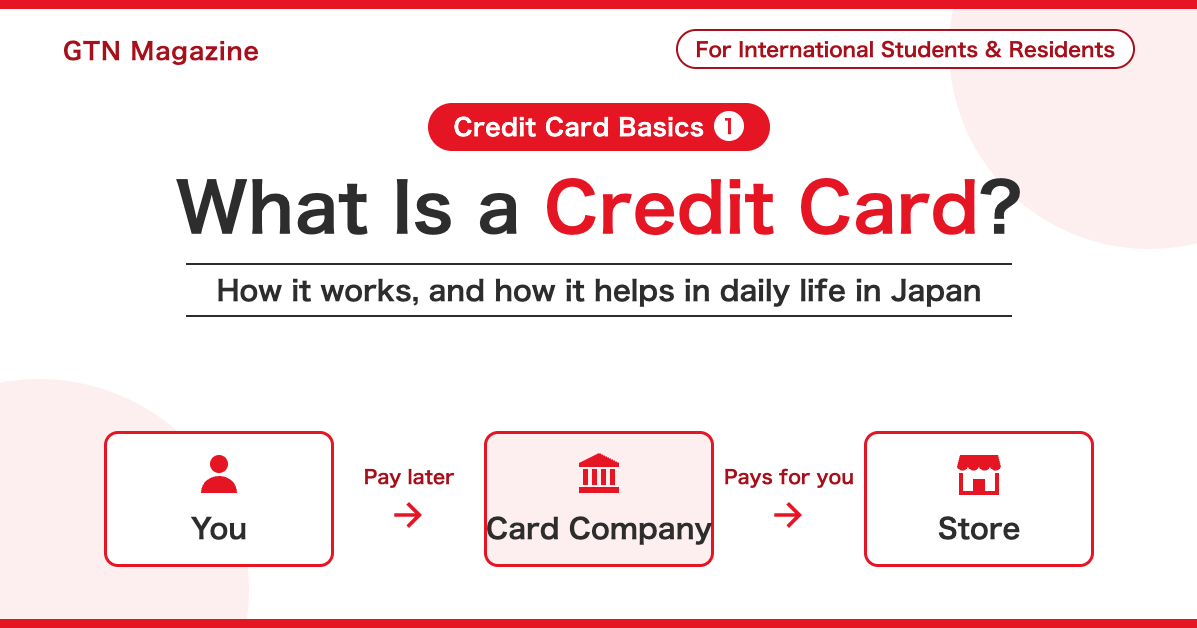
A credit card is a card that lets you make purchases now and pay for them later. When you use a credit card at a store, the money doesn't come out of your wallet or bank account right away.

In Japan, credit cards aren't just for certain people. According to the Ministry of Economy, Trade and Industry (METI), credit cards accounted for approximately 80% (82.7%) of the total value of cashless payments in Japan in 2025. Credit cards are used in many everyday situations, such as shopping at supermarkets and convenience stores, making online purchases, and paying monthly bills.

Source: Ministry of Economy, Trade and Industry (METI), "Japan's Cashless Payment Ratio for 2025" (March 2026)

How You, the Store, and the Credit Card Company Are Connected

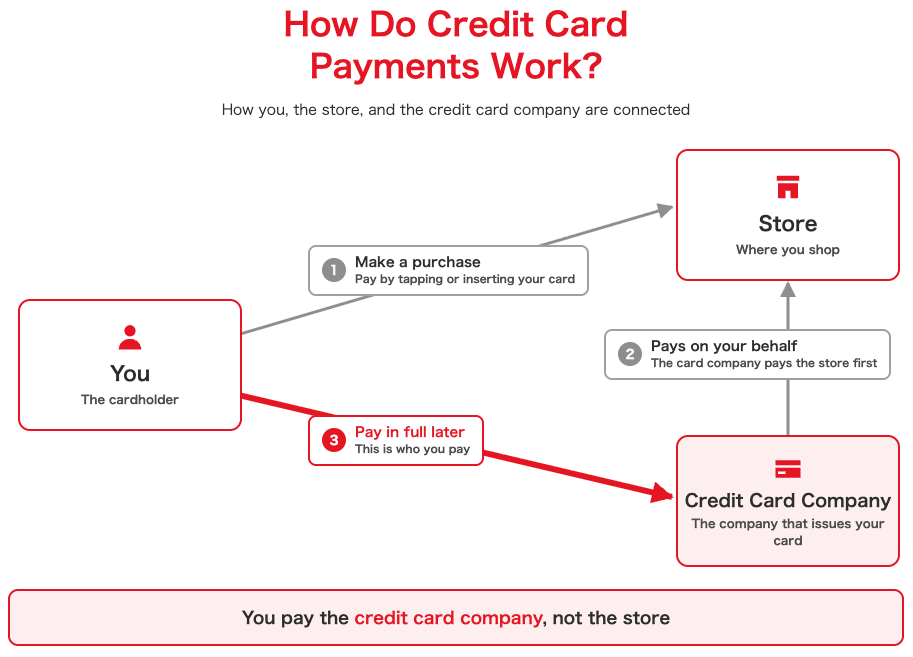
When you pay with a credit card, three parties are involved: you, the store, and the credit card company.

  1. You use your credit card to make a purchase at a store.
  2. The credit card company pays the store on your behalf.
  3. Later, you pay the credit card company for your purchase.

In other words, you pay the credit card company rather than the store directly. The credit card company pays the store first because it trusts that you'll pay the money back later. In fact, the word "credit" refers to trust.

Source: Japan Consumer Credit Association, "Credit Contract Relationships"

When and How Do You Pay for Your Purchases?

The money you spend with your credit card is automatically deducted from your bank account on a set date each month. This means the payment is taken directly from your account without you having to make it manually.

For example, the total amount you spend on purchases this month may be deducted from your bank account on a set date the following month. That's why you need to make sure you have enough money in your account before the payment date. The billing period and payment date vary depending on the credit card company. We plan to explain how this works in more detail in a separate article.

Differences Between Credit Cards, Debit Cards, and Mobile Wallets

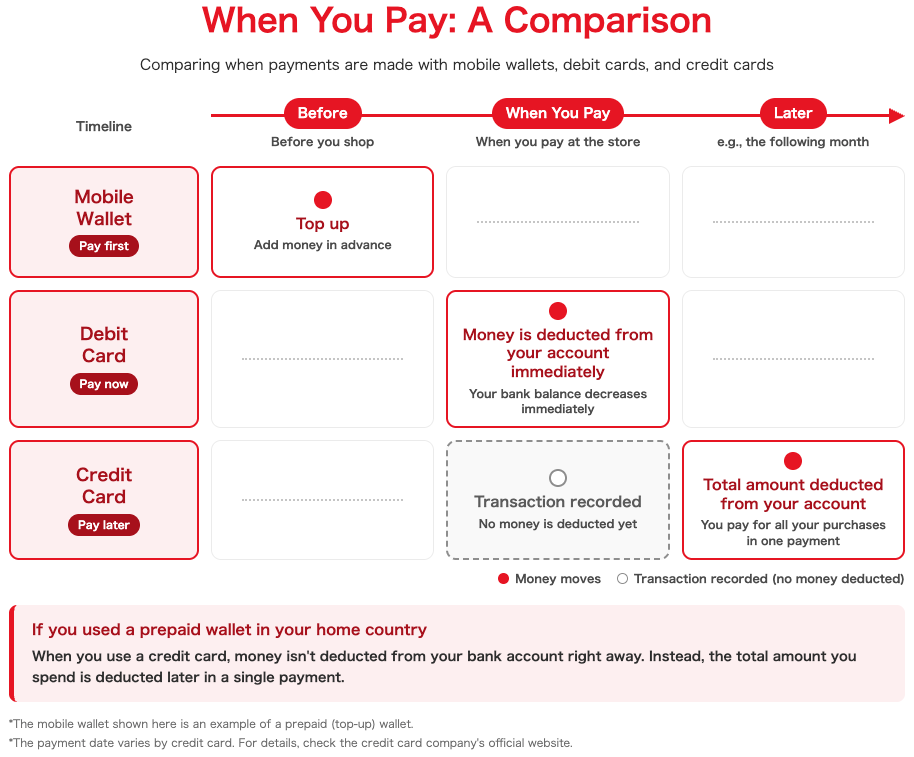
The biggest difference is when you pay. With a credit card, you pay later. With a debit card, money is taken directly from your bank account when you make a purchase. With a mobile wallet, you typically add money in advance and then use that balance to pay.

Comparing Payment Methods You May Have Used in Your Home Country

You may have used a mobile wallet in your home country. Here are some examples of popular payment services in different countries.

Country

Popular Payment Service (Example)

Payment Method

How It Works

BangladeshbKashMobile wallet linked to a phone numberPrimarily prepaid
PhilippinesGCashQR code paymentsPrimarily prepaid
IndonesiaShopeePayQR code payments (supports the QRIS standard)Primarily prepaid

*Note: Service features may change. With these mobile wallets, you add money (top up your balance) before using them. You can only spend the amount you have added. Credit cards work differently. You don't need to add money in advance, and you pay for your purchases later.

Comparing When and How You Pay


Cash

Mobile Wallet (Prepaid)

Debit Card

Credit Card

When you payAt the time of purchaseAdd money in advanceMoney is taken from your bank account immediatelyPay later through your bank account
How much you can spendThe cash you haveThe amount you've addedThe money in your bank accountUp to the limit set by the credit card company
Screening or approval requiredNoDepends on the serviceDepends on the card (some are available if you have a bank account)Yes
Risk of overspendingLowerLowerLowerRequires you to manage your spending

A debit card is linked to your bank account. When you use it, money is taken directly from your account right away. Since you can generally only spend the money you have in your account, there's less risk of overspending. However, some debit cards may not be accepted at certain stores or for certain services.

With a credit card, you can make purchases even if you don't have money in your bank account at that moment. While this is convenient, it's important to keep track of how much you're spending.

For more information about Japanese currency and when to use cash or cashless payments, check out this article:  Money in Japan: Cash vs. Cashless Payments, Currency Exchange, and How to Use ATMs

Challenges of Living with Cash Only

You can live in Japan using only cash. However, relying entirely on cash can be inconvenient in situations like these:

●  You may have to pay ATM withdrawal fees depending on the time of day or day of the week.

●  You may need to carry a large amount of cash when making expensive purchases, such as furniture or appliances.

●  If your cash is lost or stolen, it can be difficult to recover.

●  Online shopping and some monthly subscription services may have limited options for paying with cash.

If you lose your credit card, you can contact the credit card company to have it blocked. If you're charged for purchases you didn't make, you may not have to pay those charges, depending on the circumstances and the card company's policies. These conditions vary by credit card company. We plan to explain what to do if you run into problems in a separate article.

What Changes When You Link a Credit Card to a Japanese Mobile Payment App?

You may already use mobile payment apps like PayPay in Japan. These apps allow you to add money to your balance using a bank account or cash.

Some apps also let you register a credit card and select it as your payment method. However, which cards you can register and whether you can use them to make payments depend on the app, and these rules may change. For example, starting in September 2026, PayPay limited credit card payments to certain cards. Credit cards issued outside Japan cannot be registered (as of September 2026). Before using an app, be sure to check its official website for the latest information.

Source:  PayPay, "How to Register (Add) a Credit Card"

4 Situations Where Credit Cards Can Be Useful in Japan

Credit cards can be useful in four situations: renting an apartment, paying for a mobile device in installments, shopping online or paying monthly bills, and making large purchases. We'll also introduce other payment options if you don't have a credit card.


When Renting an Apartment

When renting an apartment in Japan, you usually need to pay a large amount upfront (initial costs), including a security deposit (敷金) and key money (礼金). Some real estate companies allow you to pay these initial costs by credit card.

Also, some rental agreements in Japan require you to use a rent guarantor company. This is a company that pays your landlord on your behalf if you can't pay your rent. You must then repay the guarantor company for the amount it paid. Some guarantor companies allow you to use a credit card to pay your monthly rent.

If you don't have a credit card: You may also be able to pay by direct debit (automatic payments from your bank account each month) or bank transfer. Available payment methods vary depending on the property and guarantor company.

When Paying for a Mobile Device in Installments

Some mobile phone carriers in Japan let you pay for a smartphone in installments, meaning you pay a smaller amount each month instead of the full price upfront. You can register a credit card to make these monthly payments.

However, installment plans for mobile phones require screening by the mobile phone carrier. Your installment payment history will also become part of your payment record, which we'll explain later.

If you don't have a credit card: Some mobile phone carriers allow you to make monthly payments by direct debit. You can also choose to buy the phone outright.

When Shopping Online or Paying Monthly Bills

When shopping online, you can choose to pay by credit card. Some subscription services, such as video and music streaming platforms, only accept certain payment methods, including credit cards.

You may also be able to pay utility bills, such as electricity, gas, and water, by credit card. By using one credit card for your monthly payments, you can easily check how much you've spent and what you've spent it on through your credit card statement.

If you don't have a credit card: Some online stores allow you to pay at a convenience store or choose cash on delivery (paying when you receive your order). For utility bills, you may be able to pay by direct debit or at a convenience store using a payment slip sent to you. However, some electricity and gas providers charge a fee for payments made using payment slips (e.g., TEPCO Energy Partner, Tokyo Gas, and Osaka Gas, as of October 2026).  Whether a fee applies depends on your provider and the plan you're subscribed to.

When Making Large Purchases, Such as Furniture and Appliances

When moving, you may need to make several large purchases, such as a refrigerator, washing machine, or bed. Some electronics and furniture stores accept credit cards.

With a credit card, you can make purchases even if you don't have enough cash on hand to cover the full amount. However, you'll still need to pay for your purchases later. The amount you spend will be deducted from your bank account the following month or later. Before making a purchase, make sure you'll have enough money in your account by the payment date.

If you don't have a credit card: You can also pay by debit card, mobile QR code payment (paying through an app by scanning a QR code), or cash.

Can Foreign Residents and International Students Get a Credit Card in Japan?

Foreign residents and international students may be able to get a credit card if they meet the card issuer's requirements.  Eligibility requirements vary depending on the credit card company and the type of card. Some cards are also available to students.

What You Need to Apply

Requirements vary by credit card company, but you may need the following:

Required Item

Description

Residence CardUsed to verify your identity. The card company may also check your period of stay (how long you're allowed to stay in Japan).
Address in JapanYour credit card will be delivered to your registered address.
Japanese bank accountUsed to make payments for your credit card purchases. Most credit card companies require an account in your own name.
Phone NumberUsed by the credit card company to contact you.
Proof of income (if required)Documents such as pay slips. Some credit card companies may require these depending on the type of card.

*Note: Requirements vary by credit card company. Be sure to check each company's official website before applying.

After you apply, the credit card company will review your application (a process called screening). During this process, the company checks whether it can issue you a credit card. This may include reviewing your income, period of stay in Japan, and any existing loans or debts. If you have only a short time remaining on your period of stay, it may be more difficult to get approved.

Screening results vary from person to person because everyone's circumstances are different, including whether they're studying abroad, participating in a technical intern training program, or working under the Specified Skilled Worker status.  Avoid applying for multiple credit cards within a short period.

We plan to explain what to do after receiving your credit card, including setting up your payment account, understanding your credit limit, and using your card for the first time, in a separate article.

4 Things to Know Before Getting a Credit Card

Before getting a credit card, it's important to understand payment methods and interest, cash advances, payment history, and whose name is on the card.

Paying in Full Generally Means No Fees or Interest

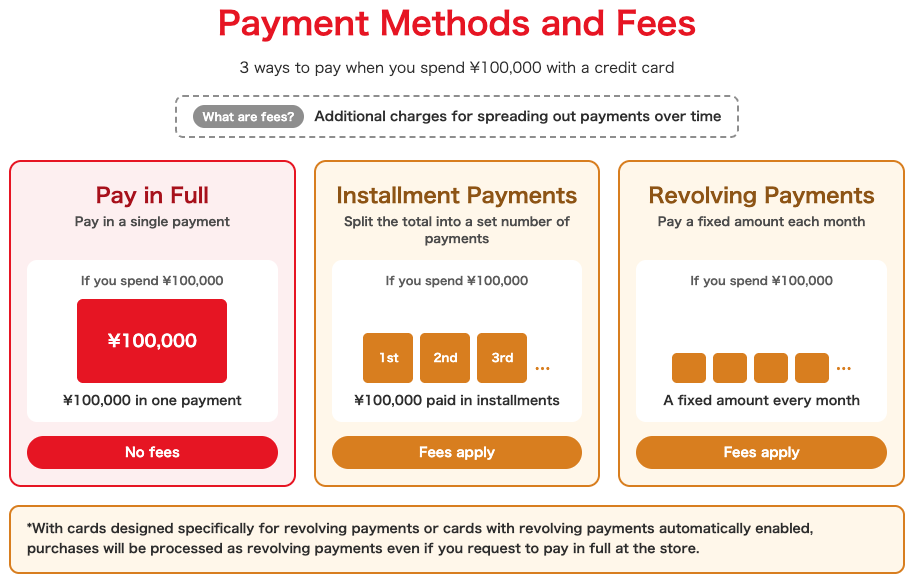
There are three main ways to pay your credit card bill.

Payment Method

How It Works

Fees

Pay in full (single payment)Pay the entire amount of your purchase in one payment.Generally no fees
Installment paymentsSplit the cost of your purchase into a set number of payments.Fees apply (some cards offer two payments with no fees)
Revolving paymentsPay a fixed amount each month.Fees apply

Fees are additional charges you pay in exchange for spreading out your payments over time. They work similarly to interest. By choosing to pay in full with a single payment, you can enjoy the convenience of a credit card without paying these fees. However, with cards designed specifically for revolving payments or cards that have revolving payments set up automatically, your purchases will be charged as revolving payments even if you choose to pay in full at the store.

Before applying, be sure to check how the card's payment method is set up. Also, even if you choose to pay in full, you may be charged late payment fees if you don't pay by the due date.

People may have different reasons for wanting to avoid transactions that involve interest, including religious or personal beliefs. For those who prefer to avoid interest, paying in full with a single payment is one option to consider. We plan to explain how installment payments and revolving payments work in more detail in a separate article.

Cash Advances Mean Borrowing Money

Some credit cards offer a feature called a "cash advance." A cash advance allows you to borrow cash using your credit card. This is different from using a credit card to make purchases and paying for them later.

Cash advances come with interest charges. You can decide whether or not to use this feature. If you don't use it, you won't be charged any interest on cash advances.

If you use a cash advance to send money to your family, for example, you'll have to pay interest on the money you borrow. We plan to explain the precautions you should take when using cash advances in a separate article.

Your Payment History Is Recorded

Your payment history for credit cards and installment plans for mobile devices is recorded by organizations called credit information agencies (credit bureaus). If you make a late payment, it may remain on your record and affect your ability to get approved for a credit card or loan in the future.

On the other hand, making payments on time is also recorded. We plan to explain more about payment history and how to use credit cards responsibly in a separate article.

Don't Let Others Use Your Credit Card or Apply for One in Your Name

Only the person whose name is on the credit card is allowed to use it. You must not lend your card to anyone, even family members or friends, or apply for a card in your name for someone else to use.

If the person using the card is different from the person whose name is on it, the cardholder is still responsible for making payments. This means you may have to pay for purchases made by someone else using your card. This may also violate the credit card company's terms and conditions, which could result in your card being suspended or canceled.

Checklist: Deciding Whether a Credit Card Is Right for You

Getting a credit card isn't necessarily the right choice for everyone. Before deciding, think about whether you need one in your daily life and whether you can manage your payments responsibly.

Do You Need a Credit Card Right Now?

Ask yourself the following questions:

●  Are there situations in your daily life where you'd like to use a credit card, such as renting an apartment, paying for a mobile device, shopping online, or paying monthly bills?

●  Can you make sure you have enough money in your bank account on your payment date each month?

●  Can you make a habit of checking how much you've spent through your credit card company's app or statements?

●  How do you feel about interest and fees? (You can also choose to pay in full with a single payment every time.)

●  How much time do you have left on your period of stay in Japan? Do you have plans to return to your home country?

If you feel that you don't need a credit card right now, that's perfectly fine. You can still manage your daily expenses using other payment methods, such as debit cards or direct debit.

What to Check Before Applying for a Credit Card

If you decide to get a credit card, be sure to check the following before applying.

What to Check

What to Look For

Annual feeA fee charged each year. Some cards have no annual fee.
Eligibility requirementsRequirements such as your period of stay in Japan, age, and whether students can apply.
Multilingual supportWhether you can get help in a language you understand if you have questions or problems.
International card networkNetworks such as Visa, Mastercard, and JCB that determine where your card can be used.
Payment method settingsWhether paying in full with a single payment is the default and whether revolving payments are automatically enabled.

Terms and services may change. Be sure to check each credit card company's official website for the latest information.

Frequently Asked Questions (FAQ)

Q. Can I get a credit card if I have a short period of stay remaining in Japan?

A. Requirements for your period of stay vary by credit card company. If you have only a short time remaining on your period of stay, it may be more difficult to get approved. Be sure to check the credit card company's eligibility requirements before applying.

Q. Can I get a credit card without a Japanese bank account?

A. Credit card payments are generally deducted from a Japanese bank account. Therefore, you may need to open a Japanese bank account before applying. Some credit card companies also require the bank account to be in your own name.

Q. Do I need to notify my credit card company if I renew my residence card?

A. If you extend your period of stay or change your status of residence, your credit card company may require you to update your information, such as by submitting a copy of your new residence card. Your card usage may also be restricted if the period of stay you previously reported has expired. 

Be sure to check any notices from your credit card company and complete the necessary procedures as soon as possible. We plan to explain this in more detail in a separate article.

Q. What should I do with my credit card when returning to my home country?

A. Before leaving Japan, make sure to pay off any remaining balances and cancel your credit card if necessary. If you leave Japan without paying what you owe, your payments may be considered overdue. We plan to explain this in more detail in a separate article.

Q. What is an international card network (such as Visa or Mastercard)?

A. An international card network is a network of stores and businesses where your credit card can be used. You can use your card at stores that display the same network logo as the one on your card. Some card networks can be used both in Japan and overseas.

Summary

A credit card allows you to make purchases now and pay for them later. In Japan, credit cards are used in many everyday situations, such as renting an apartment, paying mobile phone bills, shopping online, paying monthly bills, and making large purchases.

Foreign residents and international students may be able to get a credit card if they meet the card issuer's requirements. If you choose to pay in full with a single payment, you generally won't have to pay any additional fees. However, since payments are made later, it's important to keep track of how much you're spending.

This article is not intended to promote any particular credit card. Whether or not to get a credit card is entirely up to you, based on your lifestyle and personal preferences.

We also plan to cover the following credit card topics in separate articles:

●  Getting started with your credit card: Setting up your payment account, understanding your credit limit, and using your card for the first time.

●  Payment methods and interest: Paying in full, installment payments, revolving payments, cash advances, responsible credit card use, and payment history.

●  What to do if you run into problems: Lost or stolen cards, unauthorized charges, late payments, and what to do when returning to your home country.

関連記事

おすすめ記事