Multilingual Real Estate Services in Japan | A Complete Guide to Language Support, Services, and Choosing the Right Agency - GTN MAGAZINE
日本語
日本語
English

Multilingual Real Estate Services in Japan | A Complete Guide to Language Support, Services, and Choosing the Right Agency

This guide explains the multilingual services offered by real estate agencies in Japan, the languages available, and what to look for when choosing an agency.

From searching for a property and signing a lease to support after you move in, you'll learn how to overcome language barriers throughout the rental process.


Why foreign residents need multilingual real estate support

The language barrier is the biggest hurdle for foreign renters

For foreign residents who want to rent a home in Japan, the biggest hurdle is the language barrier.

Japanese rental contracts include many features unique to Japan—such as security deposits (shikikin), key money (reikin), and guarantors. If you go through the process without understanding these in your own language, small misunderstandings can turn into serious trouble. A multilingual real estate service removes that anxiety and gives you a reliable way to find a home with confidence.

The risks the language barrier creates in a rental contract

With a Japanese rental contract, you need to accurately understand the Explanation of Important Matters and the terms of the contract.

These documents are full of legal terminology, and even native Japanese speakers often find them difficult.

When a foreign resident signs a contract using Japanese-only documents, unexpected costs—such as restoration fees or penalty charges when moving out—can come up.

"Restoration to original condition" (genjō kaifuku) refers to the repairs needed to return the room to roughly the state it was in before you moved in. It's important to understand the rules on who pays for this before you sign.

Moving in without fully understanding the contract makes it easy to misunderstand how rent is paid, how renewal fees work, and what the move-out procedure involves. To prevent these risks, an environment where the terms are explained in your own language is essential.

Why it matters to understand the Explanation of Important Matters and the contract in your own language

Under the Building Lots and Buildings Transaction Business Act (Takuchi Tatemono Torihiki-gyō Hō), an agent is required to give an "Explanation of Important Matters" before you enter into a rental contract.

This explanation covers information that directly affects your daily life after moving in, such as the property's fixtures and equipment, the contract conditions, and the rules for cancellation.

To help foreign residents move in smoothly, the Ministry of Land, Infrastructure, Transport and Tourism (MLIT) has produced sample contracts and a room-hunting guidebook in 14 languages.

Those languages are Japanese, English, Chinese, Korean, Spanish, Portuguese, Vietnamese, Nepali, Thai, Indonesian, Burmese, Khmer, Tagalog, and Mongolian.

Multilingual real estate agencies use these official materials while staff who speak your language add their own explanations of the important matters. Because you can check the contract point by point, you can head off "I didn't know that" problems before they happen.

Japan-specific concepts—such as the difference between a security deposit and key money, how the guarantor fee works, and the restoration rules at move-out—can only be understood accurately when they're carefully explained in your own language.

What a multilingual real estate service actually supports

Multilingual real estate services do more than list properties in a foreign language

A multilingual real estate service does far more than simply introduce properties in a foreign language.

You can get language support across a wide range of situations—from property search and viewings to the contract procedure and everyday-life support after you move in.

Below, we break down the specific support by stage.

Multilingual support from property search to viewing appointments

With a multilingual real estate service, support begins the moment you describe what you're looking for in your own language.

You can discuss the fine details—your rent budget, access to work or school, floor plan preferences—in your own language.

GTN's property search site is also becoming increasingly multilingual.

Rental portal sites for foreign residents let you browse property listings in multiple languages, with photos and floor plans plus estimates of initial costs and information about the surrounding area.

Booking a viewing (an in-person look at the property) and arranging the schedule also go smoothly when a staff member who speaks your language acts as an intermediary.

Because they can handle communication with the property owner and management company on your behalf, the process is easier even when dealing in Japanese is difficult.

If you're moving to Japan from overseas, some services offer online viewings and let you check the property by photo or video. That's handy when you want to decide on a place before you arrive.

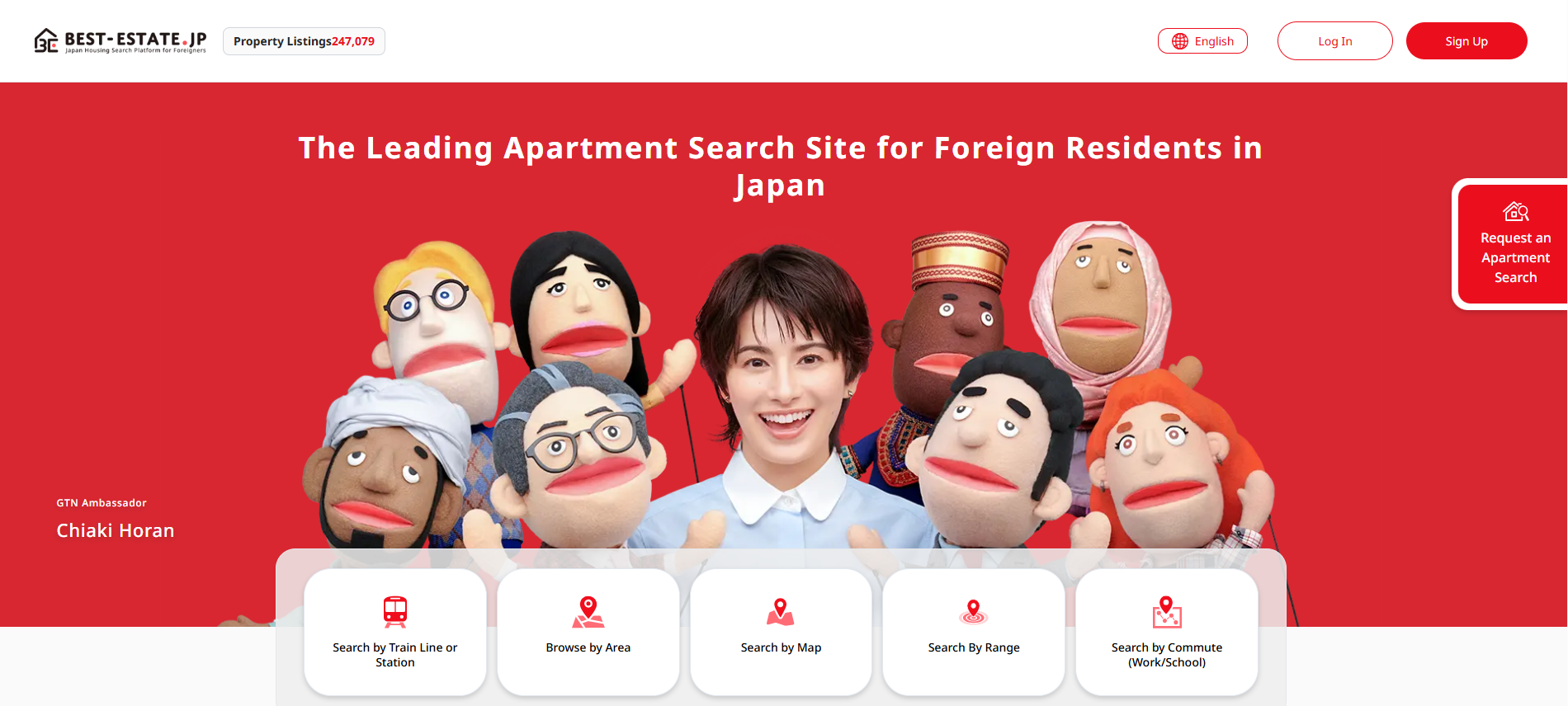
BEST-ESTATE.JP

BEST-ESTATE.JP is a rental platform specializing in services for foreign nationals.

Our multilingual team, supporting 7 languages, handles everything from property recommendations to viewings and contract signing — all completed online.

A standout feature is the ability to start your housing search seamlessly while still living overseas.

We curate only foreigner-friendly properties and offer guarantor-free plans along with 24-hour chat support.

You can search using a wide range of criteria, including no deposit/key money, furnished units, share houses, and short-term stays.

Even after move-in, GTN provides one-stop support for bank account setup, mobile phone contracts, utility arrangements, and visa renewals.


Interpretation and translation for contract procedures and the Explanation of Important Matters

The rental contract procedure has several steps, from filling out the application to screening and signing the contract.

With a multilingual service, you can get interpretation and translation support at each step.

For the tenant screening, you'll be asked to submit things like your type of residence status (visa), your period of stay, and proof of income.

It's reassuring to have the way to prepare documents and the key points of the screening explained in your own language.

For the Explanation of Important Matters, a licensed real estate agent (takken-shi) gives the explanation as required by law.

At multilingual real estate agencies, in some cases a takken-shi who speaks your language is on staff, and in others an interpreter sits in and translates the content as it's given.

Some services also provide a translated version of the contract itself.

Because you can review the content side by side with the Japanese contract, you can clear up anything unclear before you sign.

Handling problems and everyday-life support after you move in

The value of multilingual support also shows after the contract is complete. If a fixture breaks or a problem with the neighbors comes up after you move in, having a point of contact where you can consult in your own language lets you deal with it quickly.

As one example of everyday-life support, some services help in multiple languages with the procedures you need right after moving in—turning on the electricity, gas, and water; signing up for internet service; and applying for a mobile phone.

Move-out procedures are also an important area of support. Because you can go through the scope of restoration and the conditions for returning your deposit while it's explained in your own language, you can prevent trouble when you move out.

The Civil Code amendment of April 2020 made it explicit that tenants are not responsible for restoration in cases of normal wear and tear or aging (Article 621 of the Civil Code).

Who paysWhat it coversExamples
Landlord (owner)Dirt or damage from ordinary living (natural aging)Sun-faded wallpaper; floor dents from furniture
Tenant (resident)Damage or stains caused by intent or carelessnessCigarette tar stains; nail holes in the wall; drink stains

The division of responsibility is judged based on the Ministry of Land, Infrastructure, Transport and Tourism's guidelines on restoration to original condition (the "Genjō Kaifuku wo Meguru Trouble to Guideline"). If you're unsure how to judge, you can refer to these guidelines.

Three checkpoints for choosing a multilingual real estate agency

More agencies now advertise multilingual support, but quality varies

The number of real estate agencies advertising multilingual support is growing, but the quality of that service varies.

It ranges from simple machine-translation-only responses to full-fledged support with in-house staff who speak your language.

Here are the checkpoints for spotting a multilingual real estate agency you can trust.

Check the range and quality of supported languages

Even when a listing says "multilingual support," the actual level differs greatly from company to company.

What you should check isn't just the number of languages, but the level at which they support them.

Ideally, look for a company with native staff for the language you need.

At agencies with many foreign staff, you can get advice from people who also understand your cultural background.

If a company relies only on automatic translation tools, there's a risk that legal and real estate terminology will be translated inaccurately. For anything involving the contract terms in particular, human interpretation and translation is preferable.

Along with checking the supported languages, it's reassuring to confirm which communication channels—phone, email, chat—are available in your language.

Check whether they translate contract documents

Translation support for the contract and the Explanation of Important Matters document is an important measure of a multilingual service's quality.

With a company that provides a translated version of the contract, you can sign after fully grasping the terms.

Whether they use MLIT's 14-language sample contracts is another point to check.

Following the official format increases the reliability of what's written.

Check the scope of translation too.

A service is far more practical when its translation reaches beyond the contract to documents that affect daily life—such as the fire insurance explanation, the building rules, and garbage-disposal rules.

Check whether post-move-in support is available

Plenty of companies handle room-hunting and the contract in multiple languages but offer no support after you move in.

Because the language barrier often hits hardest after you've moved in, ongoing support is an important criterion.

What you should check is the support desk's hours and the number of languages it covers.

If there's a desk that offers multilingual support 24 hours a day, you can handle a nighttime emergency with peace of mind.

We recommend confirming in advance whether you can also get support for move-out procedures and contract renewals.

Things like how to pay the renewal fee and the deadline for giving move-out notice are important information for foreign residents who aren't familiar with Japanese customs.

Check itemWhat to confirmIdeal answer
Supported languagesCan you consult in the language you want?Native staff on the team
Translated documentsIs there a translated version of the contract?Translation based on the MLIT format
Post-move-in supportCan you reach them when there's a problem?A 24-hour, multilingual desk
Track recordDo they have experience serving foreign residents?Long-standing experience specializing in foreign residents
Guarantor supportDo they work with a guarantor company?Partnered with a guarantor service for foreign residents

The main languages covered and the nationalities that use these services most

The nationalities of foreign residents living in Japan are becoming more diverse, and the language support they need widens year by year.

Here we explain the languages most commonly covered by multilingual real estate services and the nationalities with the highest demand.

Major supported languages: English, Chinese, Korean, Vietnamese, and more

The five languages in highest demand at multilingual real estate services are English, Chinese, Korean, Vietnamese, and Nepali. These rank at the top among the native languages of foreign residents.

English is used as a common language by people of many nationalities.

Some services support Chinese in both simplified and traditional characters, so they can serve people from mainland China as well as Taiwan and Hong Kong.

In recent years, more services are strengthening support for Vietnamese, Nepali, and Burmese.

That's because the number of people coming to Japan on technical intern and Specified Skilled Worker programs is rising.

MLIT's room-hunting guidebook is available in 14 languages.

It covers a wide range of mainly Southeast Asian languages, including Tagalog, Indonesian, Thai, Khmer, and Mongolian.

Nationality-based needs among foreign residents and the reality of language support

As of the end of 2024, the number of foreign residents topped 3.76 million—a record high.

By nationality, the largest groups, in order, are China, Vietnam, Korea, the Philippines, Nepal, and Brazil, and rental demand centers on inquiries from these nationalities as well.

Language needs differ not only by nationality but also by residence status.

When choosing a multilingual real estate service, first confirm whether support is available in your own language.

With a company that covers many languages, it's reassuring when you later use the same service through a referral from a friend or coworker.

As the number of foreign residents grows, their nationalities and backgrounds are diversifying, and multilingual support in real estate services is becoming more important. Appropriate language support not only makes property hunting smoother but is also a key factor tied directly to a stable life after moving in.

Source: Immigration Services Agency of Japan, "Number of Foreign Residents as of the End of 2024 (Reiwa 6)"

Documents you need and what to prepare for a multilingual rental contract

Even with a multilingual service, rental documents are prepared in Japanese as a rule

Even when you use a multilingual real estate service, the documents required for a rental contract are, as a rule, prepared in Japanese.

Here we explain the documents foreign residents should prepare for a rental contract and the cases where translation becomes necessary.

Basic list of required documents

When a foreign resident signs a rental contract in Japan, the documents required differ from those for Japanese nationals. To move through the contract smoothly, prepare the necessary documents in advance.

DocumentJapanese termNotes
Passportパスポート (pasupōto)As photo ID
Residence Card在留カード (zairyū kādo)Proof of legal residence
Certificate of Employment在職証明書 (zaishoku shōmeisho)Issued by your employer
Income Certificate収入証明書 (shūnyū shōmeisho)e.g., 3 months of pay slips
Bank Account銀行口座 (ginkō kōza)For rent auto-debit

*For foreign residents who are already employed (working) in Japan.

Additional documents for students

Documents specific to international students:

  • Student ID (学生証)
  • Admission Letter (入学許可証)
  • Proof of tuition payment
  • Proof of financial support from relatives
  • Scholarship award certificate (only if applicable)

International students, who tend to have low income, may be asked for additional documents. Having proof of remittances from relatives or a scholarship award certificate helps the tenant screening go more smoothly.

Tips for preparing your documents

About translation:

  • Notarized translation is recommended for important documents
  • Some agencies can work with an English-translated version
  • It's reassuring to factor translation costs into your initial expenses

If you're anxious about preparing documents, consult a multilingual real estate agency in advance.

They can guide you through the list of required documents and how to prepare them in your own language.

The room-hunting process when using a multilingual real estate service

The room-hunting process from search to move-in, step by step

Here we explain, step by step, how the process unfolds—from room-hunting to move-in—when you use a multilingual real estate service.

Getting a picture of the whole flow in advance helps you hunt for a room efficiently.

Steps from inquiry to viewing

It all starts with contacting a multilingual real estate agency.

Many companies offer several ways to get in touch—phone, email, a web form, LINE, and more.

The four basic pieces of information to give when you inquire are your preferred area, your maximum rent, your desired move-in date, and your type of residence status.

Once you provide these, they'll suggest properties that match your conditions.

When you find a property you like, book a viewing.

On the day of the viewing, a staff member explains the property's fixtures and the surrounding area in your own language.

Check the things that are hard to tell from photos—the water fixtures, storage, and how much sunlight comes in.

If you want to decide on a place before arriving from overseas, it's convenient to choose a service that supports online viewings. You can check out the property over a video call and ask questions in your own language.

From application through screening to a completed contract

Once you've settled on the property you want to live in, you submit an application.

At a multilingual real estate agency, you can also get help filling out the application.

The tenant screening confirms your ability to pay rent based on your income, residence status, and employer information.

For foreign residents, using a guarantor company is required in most cases.

At a real estate agency partnered with a guarantor company that specializes in foreign residents, the screening tends to go more smoothly.

Once you pass screening, you move on to the Explanation of Important Matters and signing the contract. This is the stage where you also pay the initial costs.

ItemExample amountTypical market rateRefundable?Description
Security deposit (shikikin)¥0–80,0000–1 month's rent (tax-free)Partly refunded at move-outSecurity for repair costs
Key money (reikin)¥0–80,0000–1 month's rent (tax-free)Non-refundableGratuity to the landlord
Brokerage fee¥88,0001 month's rent + taxNon-refundableThe agency's fee
Advance rent¥80,0001 month's rent (tax-free)Non-refundableProrated rent for the move-in month plus the next month's rent
Guarantor fee¥40,000–80,0000.5–1 month's rent (tax-free)Non-refundableFee for using a guarantor company
Fire insurance premium¥15,000–20,000¥15,000–20,000 (tax-free)Non-refundableRepair costs in case of disaster or accident
Key replacement fee¥15,000–30,000¥15,000–30,000Non-refundableSecurity measure
Total (example):¥238,000–458,000   

*Security deposit and key money may be 2 months for luxury or pet-friendly properties.

*The example amounts above are calculated assuming rent of ¥80,000.

*The brokerage fee may differ depending on the agency and the contract terms.

After the contract is complete, you receive the keys and move in. You need to arrange for electricity, gas, and water to be turned on by your move-in date. Using a multilingual one-stop service for setting up utilities gets these procedures done all at once.

Living with peace of mind by making the most of multilingual real estate services

Multilingual real estate services support your whole life in Japan, not just the search

Multilingual real estate services aren't just the entry point to room-hunting—they become a foundation that supports your entire life in Japan.

Here we share how to make use of post-move-in support, along with a summary of the whole article.

Using a support system where you can consult in your own language after moving in

Common problems that come up after moving in include broken fixtures, noise issues, questions about garbage-disposal rules, and contract renewal procedures. Having a support desk in your own language for these situations leads to faster resolution.

Depending on the service, some offer a life-support desk available 24 hours a day, 365 days a year in multiple languages. Before using one, check the supported languages, the hours, and the types of problems they handle.

GTN has 20 years of experience supporting foreign tenants and can respond in up to 25 languages. It works with more than 42,000 partner real estate companies, and its cumulative contracts have reached about 550,000. With support available up to 24 hours a day, 365 days a year (some support services are closed over the New Year holidays), it maintains a within-the-month resolution rate of about 97%.

Move-out is a point where trouble easily arises over the scope of restoration and the amount of the deposit refund.

By using multilingual support to understand the pre-move-out checklist and the procedure in your own language, you can complete your move-out smoothly.

To keep your life in Japan stable, you need an environment where you can casually consult someone about housing issues.

We recommend treating a multilingual real estate service not as "just a way to rent a room" but as "someone to turn to for life's questions."

Summary and next steps

This article has explained multilingual real estate services—from why they're needed to what they support, how to choose one, and how the process works.

Here are the five points foreign residents should keep in mind to rent a place in Japan with confidence:

  • The language barrier in a rental contract can be overcome with a multilingual real estate service
  • Choose a service that offers consistent support in your own language, from property search through the contract and after you move in
  • Look beyond the number of languages to whether they have native staff and the quality of their translated documents
  • Prepare the required documents early, and if translation is needed, factor the cost into your initial expenses too
  • Choosing a service with strong post-move-in life support lets you live with confidence over the long term

As a first step in your room hunt, try reaching out to a multilingual real estate service. BEST-ESTATE.JP lets you search for properties in multiple languages. Why not start by telling them your preferences and looking for a property that fits you?

関連記事

おすすめ記事