
日本語
日本語
English

Complete Guide to Choosing a Real Estate Agency in Japan | 7 Things to Check to Avoid Being Turned Away
“You cannot rent this property because you are a foreign national.”
If you are looking for an apartment in Japan, you may hear something like this. It can happen even if you have a stable income or speak Japanese. The reason often lies in outdated practices and concerns that still exist in Japan’s rental housing industry.
One of the quickest ways to find a home is not simply to look for the right property, but to choose a real estate agency that has experience assisting foreign residents. An experienced agency can address landlords’ concerns and work with you to find ways to improve your chances of passing the screening process.
GTN operates a rental property website specializing in housing for foreign residents and has supported more than 700,000 foreign residents in Japan over the 20 years since its establishment. Around 70% of GTN’s staff are foreign nationals, and support is available in 25 languages.
Drawing on that experience, this article explains how to identify a good real estate agency. We’ll keep things simple and walk you through the key points you can check yourself before contacting an agency.
Why Is It Harder for Foreign Residents to Find an Apartment in Japan?
Being turned down does not necessarily mean that your income is too low or your Japanese is not good enough. The real issue is often that landlords worry about what might happen if a problem comes up and do not know how to handle it. First, let’s look at some of the concerns landlords may have.
4 Common Concerns Landlords Have
- Unpaid rent
- Landlords may worry that if a tenant leaves their job or suddenly returns to their home country and stops paying rent, it could be difficult to recover the unpaid amount.
- Communication difficulties
- If something breaks in the apartment or there is a problem with a neighbor, a language barrier can make it more difficult and time-consuming to resolve the issue.
- Differences in everyday rules and customs
- Rules for things like sorting garbage and keeping noise down at night may differ from country to country, which can sometimes lead to concerns about potential problems.
- Difficulty communicating the terms of the lease
- Landlords may worry that the terms have not been fully understood, which could lead to disagreements when the tenant moves out.
Ultimately, many of these concerns come down to one thing: landlords may not know what to do if an unexpected problem occurs. By choosing a real estate professional with experience supporting foreign residents, many of these concerns can be addressed, making the apartment search much smoother.
The Reality Foreign Residents Face When Looking for Housing in Japan
Let’s take a look at the results of the FY2025 Basic Survey on Foreign Residents, conducted by Japan’s Immigration Services Agency, which received responses from 8,874 people.
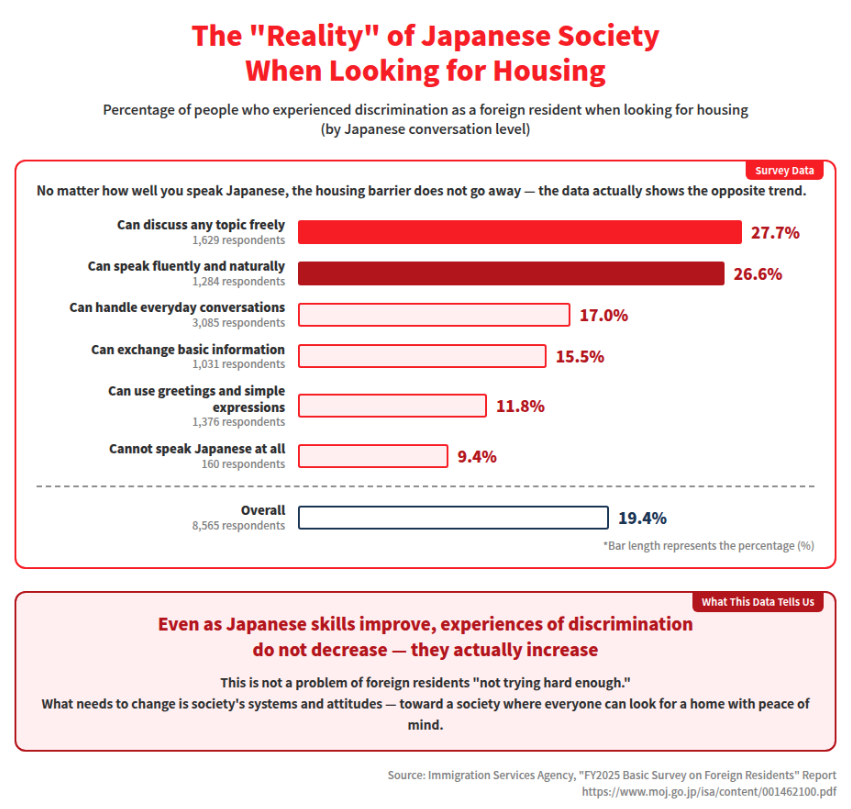
Among situations in which respondents felt they had been treated unfairly, “when looking for housing” was the most common response at 19.4%. This was higher than both “when looking for a job” (13.2%) and “at their current workplace” (17.5%).
The survey also asked respondents who had made them feel uncomfortable. Excluding acquaintances and coworkers, real estate agency staff accounted for 23.8%, suggesting that problems can arise in the way foreign residents are treated during the apartment search process (Source: Immigration Services Agency, FY2025 Basic Survey on Foreign Residents Report).
More concerning is that the percentage increased by 2 points from 17.4% the previous year rather than improving. This suggests that it is not a simple problem that will naturally disappear over time.
In other words, difficulty finding an apartment is not simply an issue on the applicant’s side. It is a structural problem tied to the long-standing practice of some landlords and rental properties not accepting foreign tenants. Even people who speak Japanese fluently can encounter this barrier.
Interestingly, the survey also suggests that people with higher Japanese speaking ability may be more likely to report such experiences. Let’s look at the figures by Japanese conversation level in the table below.
| Japanese Speaking Level | Number of Respondents | Experienced Discrimination When Looking for Housing |
|---|---|---|
| Can communicate appropriately according to the situation and the person they are speaking with, regardless of the topic | 1,629 | 27.7% |
| Can speak fluently and naturally | 1,284 | 26.6% |
| Can handle conversations necessary for daily life | 3,085 | 17.0% |
| Can exchange basic information on familiar topics | 1,031 | 15.5% |
| Can use common greetings and everyday expressions | 1,376 | 11.8% |
| Cannot speak Japanese at all | 160 | 9.4% |
| Overall | 8,565 | 19.4% |
(Source: Immigration Services Agency, FY2025 Basic Survey on Foreign Residents Report)
Comparing the figures, there is nearly a threefold difference between the highest and lowest percentages. This does not mean that speaking Japanese puts you at a disadvantage. One possible explanation is that people who are confident in their Japanese are more likely to visit and communicate directly with real estate agencies, giving them more opportunities to encounter this type of treatment.
In other words, even if you become fluent in Japanese, that alone will not automatically remove the barriers to renting an apartment. What matters more than language ability is finding a real estate agency that welcomes you and is willing to support you.
For more information on the screening process, see our guide to the 3 Tips for Passing a Rental Application Screening.
Government Efforts to Address Rejections Based Solely on Nationality
The Japanese government also recognizes unequal access to housing as a serious issue. The Ministry of Land, Infrastructure, Transport and Tourism (MLIT) has developed guidelines to help foreign residents rent privately owned housing more smoothly. These guidelines are designed to address concerns among landlords and real estate agencies and make it easier for them to accept foreign tenants.
The guidelines include sample rental documents available in 14 languages, as well as checklists to help ensure that important steps in the rental process are not overlooked. These resources are available free of charge for anyone to use (Source: Ministry of Land, Infrastructure, Transport and Tourism: Support for Smooth Access to Private Rental Housing for Foreign Residents).
In other words, resources to help address these issues are already available. What matters is whether the real estate agency you choose has the knowledge and experience to make effective use of them. Look for professionals who respect you as a customer and take your needs seriously. You have the right to choose an agency you feel comfortable working with as you search for the right home.